What do you actually sell when you sell your business? A sole proprietorship is an “enterprise” registered with SSM (the Companies Commission of Malaysia). If you own one, you sell its assets one by one: equipment, stock, customer lists and goodwill. The business and you are legally the same person, so there is no separate thing to hand over. A Sdn Bhd is a private limited company. If you own one, you can sell your shares instead. The company then passes to the buyer with its contracts, bank account, registration and history still attached. Boss Boleh prepares the share transfers, director changes and bank resolutions that a share sale needs, so we see this difference from the company secretary’s side.
📌 Quick summary
- Selling an enterprise means selling assets. Your contracts, licences and SSM registration stay with you, and the buyer starts fresh.
- Selling a Sdn Bhd usually means selling shares. The company keeps everything, including its debts, so buyers check its records closely.
- Stamp duty applies to a transfer of unlisted Sdn Bhd shares. Asset transfers can attract stamp duty too, depending on which assets move.
- If you might sell within a few years, settle the Enterprise vs Sdn Bhd question early.
About the Author:
This guide is written by Boss Boleh, a licensed online company secretary built for first-time entrepreneurs in Malaysia. Our team advises owners on choosing between Enterprise and Sdn Bhd.
📌 What changes hands when you sell an enterprise versus a Sdn Bhd?
One legal fact decides what a buyer can take over. A Sdn Bhd is a separate legal entity, which means the law treats it as a person of its own. A sole proprietorship is not a separate entity.
| Item | Enterprise (sole proprietorship) | Sdn Bhd (share sale) |
|---|---|---|
| What you sell | Assets, one by one | Shares in the company |
| Contracts and licences | Belong to you. The buyer must sign or apply again. | Belong to the company. They generally stay in place. |
| SSM registration | Yours. The buyer registers their own business. | The company keeps its registration number. |
| Past debts | Stay with you personally | Stay with the company, so the buyer inherits them |
| Company secretary | Not required | Required (Section 235) |
🔔 QUICK TAKE AWAY
In an enterprise sale, you sell the things you own. In a Sdn Bhd sale, you sell the owner of the things.
📌 Why does limited liability matter when you sell?
Liability follows that same legal owner. A limited liability company in Malaysia, such as a Sdn Bhd, owns its own debts. Its shareholders generally risk only the money they put in.
- Sdn Bhd share sale: The company’s past debts and disputes stay inside the company, so the buyer inherits them. That is why buyers run due diligence (a check of the company’s records, contracts and filings). They also ask for warranties, which are written promises about the company’s condition.
- Personal guarantees: You may have signed a personal guarantee for a company loan. Selling your shares does not end that guarantee by itself. Ask the lender to release you as part of the deal.
- Enterprise sale: You carry unlimited personal liability. Debts from your time as owner stay with you after the sale.
A Sdn Bhd also gives you a second route. Some buyers prefer to buy the company’s assets rather than its shares, so they avoid inheriting unknown problems. With a Sdn Bhd you can sell either way. With an enterprise, an asset sale is your only option.
📌 How much stamp duty and tax does each sale attract?
Liability is about risk. The next question is cost. Tax on a business sale depends on your own facts, so treat this as a guide, not tax advice.
- Stamp duty on a share transfer: LHDN (the Inland Revenue Board of Malaysia) charges stamp duty on the transfer of unlisted Sdn Bhd shares. The amount depends on the value of the shares.
- Enterprise asset sale: Ad valorem stamp duty is a duty based on value. On the documents that transfer the assets, it runs at tiered rates, depending on which assets move.
- Capital gains tax: If a company owns the shares (for example, a holding company), a capital gains tax on unlisted shares may apply in some circumstances. Check LHDN’s current rules.
The sale agreement decides whether she or the buyer pays it.
🔔 QUICK TAKE AWAY
Every RM100,000 of share value means RM300 of stamp duty.
Before you agree a price, bring your numbers to our free Enterprise vs Sdn Bhd webinar, or WhatsApp our tax team.
📌 What paperwork does each type of sale need?
Once the price is set, the paperwork is where the two structures differ most in practice.
Sdn Bhd share sale:
- Sign a sale and purchase agreement. A lawyer usually prepares it.
- The seller signs the share transfer form.
- Stamp the form with LHDN.
- The board approves the transfer and updates the register of members. Then the change is reported to SSM.
- Update the beneficial owner (BO) records. The BO is the real person who ultimately owns or controls the company.
- Change directors and bank signatories by board resolution, if management changes.
Every Sdn Bhd must have at least one qualified company secretary (Section 235). In practice, the secretary prepares these resolutions, keeps the registers and lodges the SSM forms. The directors keep their own duties.
Enterprise asset sale:
- Sign an asset sale agreement that lists each asset, including goodwill.
- Transfer each asset, and stamp the documents that need it.
- The buyer registers their own business and applies for their own licences.
- Notify SSM that your business has stopped trading. Your personal tax file stays with you.
📌 Why do strong compliance records raise what a buyer will pay?
Paperwork completes a sale, but trust sets the price. A buyer judges your business on its records as well as its profit. A buyer’s due diligence checks the company’s SSM filings:
- Annual Return: generally lodged within 30 days of the incorporation anniversary (Section 68).
- Financial statements: for a private company, generally lodged within 30 days after they are sent to members, unless an extension is approved (Section 259).
Late filings stay on record after you catch up, and buyers will see them. An enterprise has a different problem: its track record belongs to you, not to something that can change owners. If a sale is in your plan, an early switch lets the company build its own history. Boss Boleh can set up a Sdn Bhd in 2 days, fully online with eKYC (electronic Know Your Customer identity checks) and digital signatures.
📌 Frequently Asked Questions
Can I sell my sole proprietorship in Malaysia?
Yes, but you sell the assets and goodwill. The SSM registration is personal to you, so the buyer registers their own business.
How is stamp duty on a share transfer calculated?
For unlisted Sdn Bhd shares, LHDN charges stamp duty on the share transfer form, based on the value of the shares. Confirm the current rate before stamping.
Do I need a company secretary in Malaysia to sell my Sdn Bhd?
Your Sdn Bhd must already have a qualified company secretary (Section 235). The secretary prepares the transfer resolutions and updates the registers.
Must my company secretary be in Kuala Lumpur?
No. A company secretary in Kuala Lumpur is common, but the law does not require it. The secretary must be qualified (Section 235(2)) and ordinarily resident in Malaysia. Boss Boleh serves every state online.
Should I convert to a Sdn Bhd right before selling?
Usually this gains little. The new company has no track record, and moving assets into it is itself a transfer that may attract stamp duty. Converting earlier works better.
ABOUT BOSS BOLEH
Boss Boleh is a licensed company secretary and online incorporation platform built for first-time entrepreneurs. Beyond company secretarial work, it also offers a one-stop compliance solution for entrepreneurs, including accounting, tax planning and tax filing services. We handle Annual Return and Beneficial Owner submissions to SSM, plus the standard resolutions, such as director changes and bank account resolutions, that keep a company ready for a buyer’s checks. Enterprise owners can switch early with our 2-working-day incorporation and free “Enterprise vs Sdn Bhd” webinar.
References
- Companies Act 2016 (Act 777), sections 68, 235 and 259
You’re welcome to join our community group to get exclusive and latest trend of business insight!
Want to learn more about managing your business structure the right way? 💼
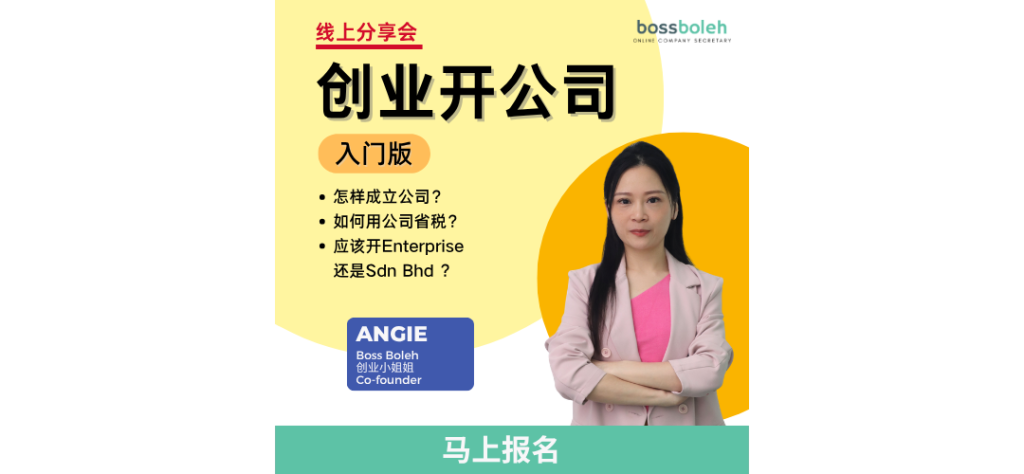
Join our FREE webinar! We’ll walk you through compliance essentials and how to convert from Enterprise to Sdn Bhd with confidence.
For more details, feel free to WhatsApp us!
📲 WhatsApp: 018-7678055